- Nov 22, 2026
- Hits: 0
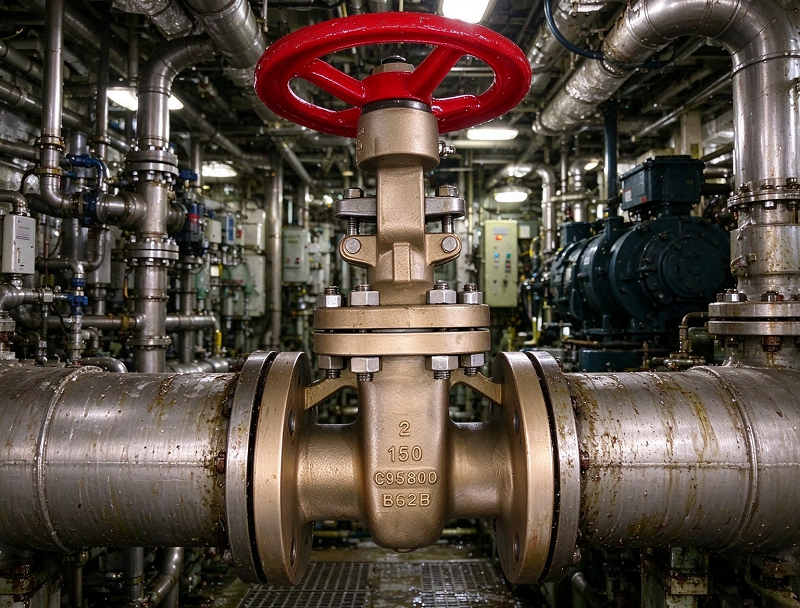
Engineers are increasingly specifying C95800 nickel aluminum bronze for critical isolation points in desalination, offshore, and marine piping. Here is why the 2-inch Class 150 flanged gate valve stands out—and what makes the material itself so effective.
In marine and offshore industries, corrosion is not just a maintenance issue—it is a safety and operational risk. Seawater contains chlorides that aggressively attack carbon steels and even many stainless steel grades. For decades, engineers relied on bronze and brass for seawater service, but as operating pressures and temperatures rise, conventional materials often fall short.
Enter C95800 nickel aluminum bronze. This high-strength copper alloy has become the material of choice for critical seawater valves, and the 2-inch Class 150 flanged gate valve is a prime example of how this alloy is reshaping pipeline reliability.
C95800 is a cast nickel aluminum bronze alloy specified under ASTM B148 (UNS C95800). Its nominal composition is carefully balanced to deliver performance that conventional bronzes cannot match:
Copper (Cu): Minimum 79%, forming the base matrix.
Aluminum (Al): 8.5–9.5%, the critical alloying element responsible for strength and the protective oxide film.
Nickel (Ni): 4.0–5.0%, improving corrosion resistance, raising yield strength, and stabilizing microstructure.
Iron (Fe): 3.5–4.5%, acting as a grain refiner and increasing tensile strength.
Manganese (Mn): 0.8–1.5%, contributing to microstructural stability.
The metallurgy of C95800 is complex. It is a two-phase alloy, and small variations in composition or heat treatment can produce markedly different microstructures—which in turn affect corrosion resistance and mechanical performance. This is why reputable manufacturers must carefully control casting and heat treatment processes. Research has shown that when aluminum content falls below the specified 8.5% minimum, corrosion resistance deteriorates significantly. Maintaining the correct composition is essential for long-term reliability in seawater.
The outstanding seawater resistance of C95800 comes from its ability to form a thin, adherent protective surface film when exposed to corrosive media. This film is layered: the inner layer is rich in aluminum oxide (Al₂O₃), while the outer layer is richer in copper oxide (Cu₂O). Nickel and iron oxides also contribute, and over time, copper hydrochlorides can further enhance the protective layer in marine environments.
This oxide film is what allows C95800 to resist the aggressive chloride attack that destroys lesser materials. The alloy is specifically noted for superior resistance to salt water corrosion, making it suitable for continuous immersion and high-flow seawater systems. It also performs well in hot and cold seawater, neutral and acidic aqueous media, and non-oxidizing acids.
Seawater systems rarely involve static conditions. Pumps, valves, and piping experience constant turbulence, and in high-velocity areas, cavitation and erosion can rapidly degrade softer materials. C95800 is specifically formulated to resist these mechanisms.
The alloy offers high resistance to erosion and cavitation, a property particularly valued in valve and pump components where fluid velocity is highest. This makes it ideal for seawater intake lines, cooling water circuits, and firefighting systems where flow rates are substantial and reliability is non-negotiable.
While corrosion resistance is the headline property, C95800 also delivers impressive mechanical performance. In the sand-cast condition (typical for valve bodies), typical minimum values include:
Tensile Strength: 585 MPa (85 ksi)
Yield Strength (0.5% extension): 240 MPa (35 ksi)
Elongation: 15%
These values are significantly higher than those of conventional tin bronzes and brasses. The higher strength allows valves to withstand greater pressure loads and mechanical stress without deformation or failure. It also means components can be designed with thinner walls or smaller profiles without sacrificing safety margins—an important consideration in space-constrained marine piping systems.
Two additional properties make C95800 particularly suitable for valve manufacturing. First, the alloy offers good pressure tightness, essential for preventing leakage in high-pressure seawater systems. Second, it has excellent weldability, which facilitates manufacturing and allows for repairs or modifications when necessary. This combination of castability, machinability, and weldability makes C95800 a practical choice for industrial production.
The valve featured in this news is a 2-inch (DN50) Class 150 flanged gate valve with a bolted bonnet, rising stem (OS&Y), and manual handwheel. Key specifications include:
Body and Bonnet Material: ASTM B148 UNS C95800 Nickel Aluminum Bronze
Pressure Rating: Class 150 LB (PN20)
Connection: Raised-face flanged ends (ASME B16.5)
Design: Bolted bonnet, OS&Y rising stem for clear position indication
Operation: Manual handwheel
The OS&Y (Outside Screw and Yoke) design keeps the stem threads outside the process media, protecting them from corrosion and debris. This is especially important in seawater service, where stem thread degradation can lead to valve failure. The rising stem also provides a clear visual indication of the valve's position (open or closed), which is critical for safety and operational efficiency.
The 2" Class 150 C95800 gate valve is designed for demanding environments, including:
Seawater Intake and Cooling Systems: Reliable isolation for ship engines, offshore platforms, and coastal power plants.
Desalination Plants: Corrosion-resistant construction for reverse osmosis (RO) and multi-stage flash (MSF) processes.
Marine Piping: Bilge, ballast, and firefighting systems on vessels.
Chemical Processing: Handling of brine, chlorides, and other corrosive media.
Offshore Oil and Gas: Utility and seawater service lines on platforms.
To maximize the service life of a C95800 gate valve, consider the following:
Proper Installation: Ensure the valve is installed with the handwheel accessible and the flow direction matching the arrow (if indicated).
Regular Operation: Periodically cycle the valve to prevent seizing, especially in infrequently used lines.
Inspection: Check for stem leakage and flange integrity during routine maintenance.
Avoid Over-Torque: Use the handwheel only; do not use extension bars that could damage the stem or bonnet.
As global infrastructure ages and new offshore projects move into deeper, more corrosive environments, the demand for high-performance alloys like C95800 is rising. While the initial cost of nickel aluminum bronze is higher than standard bronze or carbon steel, the total cost of ownership is often lower due to reduced maintenance, longer service life, and fewer unplanned shutdowns.
Industry analysts also note a growing trend toward standardization: more project specifications now explicitly call for C95800 in seawater service, replacing older material designations like C83600 or C92200.
The 2" Class 150 C95800 nickel aluminum bronze flanged gate valve represents a practical, proven solution for seawater and corrosive service. Its combination of high strength, excellent corrosion resistance, and reliable OS&Y design makes it a smart choice for engineers and procurement teams alike. Understanding the material science behind C95800—from its carefully balanced composition to its protective oxide layer and erosion resistance—explains why this alloy has earned its place in the most demanding marine environments.
For more information on our C95800 valve range or to request a datasheet, please contact our sales team.
JONLOO valve company is a professional manufacturer of industrial valves, specializing in bronze, stainless steel, and high-performance alloy valves for marine, offshore, and industrial applications. With years of export experience and a commitment to quality, we provide reliable flow control solutions to customers worldwide.