As the world accelerates its transition toward carbon neutrality, hydrogen has firmly established itself as a cornerstone of the global clean energy ecosystem. As the lightest and most abundant molecule in the universe, it serves as a vital energy carrier across diverse sectors, including sustainable transportation, large-scale power generation, and high-tech chemical manufacturing. Green hydrogen, produced through the electrolysis of water using renewable energy sources such as solar, wind, and hydropower, offers a promising zero-emission alternative to fossil fuels, underpinning the future of industrial decarbonization.
However, the unique physical and chemical properties of hydrogen present significant engineering challenges. Its minuscule molecular size, high flammability, and potent reactivity demand specialized handling solutions. At the heart of any safe hydrogen infrastructure lie high-pressure ball valves engineered specifically for hydrogen service. These critical components must resist not only extreme pressure but also the pervasive threat of hydrogen embrittlement, making their design and material selection a sophisticated technical endeavor.
Conventional valves, typically designed for water, oil, or natural gas, rapidly degrade when exposed to high-pressure hydrogen environments. Over time, the metal structure becomes brittle, losing its ductility and ability to absorb stress, which can lead to unexpected cracking, seal failure, and hazardous leaks. This article delves into the core technical specifications, material science, and engineering principles required to design and manufacture reliable hydrogen-resistant ball valves, ensuring operational safety and minimizing costly downtime.
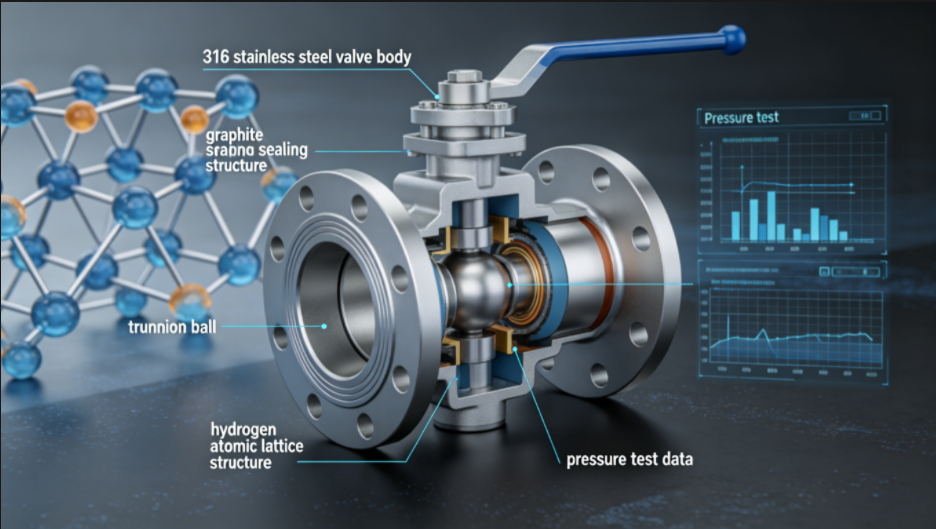
Hydrogen embrittlement (HE) represents one of the most insidious threats to metal components in high-pressure hydrogen systems. It is a complex metallurgical phenomenon where atomic hydrogen infiltrates the crystalline lattice structure of a metal, significantly reducing its ductility and load-bearing capacity.
This process typically occurs during manufacturing stages such as electroplating, welding, heat treatment, or through environmental corrosion. Unlike molecular hydrogen, atomic hydrogen is small enough to penetrate grain boundaries and internal defects. Once trapped, it accumulates, creating internal pressure that weakens inter-atomic bonds. This initiates the formation of microcracks, which can rapidly propagate under even moderate mechanical stress, leading to sudden and catastrophic failure without any visible warning.
The risk intensifies dramatically in applications exceeding 350 bar (35 MPa). At these pressures, hydrogen atoms are forced deep into the material's surface. Combined with mechanical stress from operation or thermal expansion, this creates a perfect storm for crack initiation. Even minor surface imperfections or machining marks can act as stress concentrators, accelerating the embrittlement process. For manufacturers like JONLOO Valve, addressing this invisible enemy is paramount to ensuring the integrity of trunnion ball valves for hydrogen service.
Selecting the right materials is the foundation of building a durable hydrogen-resistant ball valve. The industry has established clear guidelines based on rigorous material science and field experience.
Austenitic stainless steels, particularly Grade 316 and 316L, are the undisputed industry benchmark for hydrogen resistance. Their face-centered cubic (FCC) crystalline structure (austenite) is inherently stable and resistant to hydrogen diffusion.
A critical industry requirement is a minimum 12% nickel (Ni) content. This high nickel concentration is essential to stabilize the austenitic phase, preventing a potentially dangerous transformation into martensite, a phase highly susceptible to embrittlement. This stability ensures 316/316L maintains its ductility and toughness even under extreme pressure and temperature fluctuations. Additionally, these alloys offer excellent corrosion resistance, making them ideal for the harsh chemical environments found in hydrogen production and storage. Their performance at cryogenic temperatures (down to -196°C) further expands their versatility for liquid hydrogen applications. For ultra-high pressure scenarios (above 1000 bar), modified grades with enhanced molybdenum or nitrogen content are often employed to boost strength.
For critical moving parts subjected to repeated high loads, such as valve stems, ball seats, and internal springs, standard 316L may lack the necessary strength. Here, specialty alloys step in.
- XM-19 (Nitronic 50): This nitrogen-enhanced austenitic stainless steel offers exceptional yield strength combined with outstanding corrosion and hydrogen resistance. It provides an ideal balance of properties for demanding valve components.
- Inconel 718: A nickel-based superalloy, Inconel 718 boasts superior high-temperature strength and creep resistance. With a minimum yield strength exceeding 690 MPa, it is the material of choice for valves operating in high-temperature hydrogen environments or under cyclic pressure loads.
Beyond material selection, the physical design of a hydrogen ball valve must incorporate specific features to mitigate risks and ensure performance.
Given hydrogen's tiny molecular diameter (approximately 0.28 nm), even the smallest gaps can lead to significant leakage. Therefore, a robust sealing system is non-negotiable.
- Materials: Valves utilize specialized non-metallic seals, such as Virgin PTFE or compressed graphite, which have very low hydrogen permeability.
- Design: Precision-machined sealing surfaces, combined with advanced packing arrangements (e.g., graphite packing with anti-extrusion rings), create a near-perfect barrier. Metal-to-metal seals are also employed for high-pressure, zero-leakage applications.
- Avoidance: Standard rubber or low-grade plastic seals are strictly avoided due to their high hydrogen permeability.
The valve body and internal components are engineered to withstand extreme forces.
- Connection Methods: For pipelines with operating pressures ≥ 2.5 MPa, secure flange connections (like tongue-and-groove, ring joint, or double offset butterfly valve flanges) or butt-weld ends are specified to ensure structural integrity under pressure.
- Flow Path Optimization: The internal geometry is designed to minimize dead legs or stagnant zones where hydrogen could accumulate and induce localized embrittlement. Smooth flow paths also reduce turbulence and pressure drop.
Compliance with recognized global standards is not just a formality; it guarantees a minimum level of safety and performance. Key standards for hydrogen valve design and testing include:
- ISO 19880-3:2018: Specific requirements for valves in hydrogen fuelling stations.
- ASME B31.12: Code for the design, construction, and testing of hydrogen piping and pipelines.
- ISO 14687: Specification for hydrogen fuel quality, ensuring compatibility with valve materials.
- EN 13643: Safety requirements for pressure relief devices on cryogenic vessels.
- API 608: Standard for fire-safe design of ball valves.
- GB/T 34542: Chinese national standard for equipment in hydrogen fuelling stations.
The safe and efficient utilization of hydrogen energy hinges on the availability of high-performance flow control equipment. Hydrogen embrittlement remains a formidable technical barrier, but through advanced material science—specifically high-nickel austenitic stainless steels and specialty superalloys—and rigorous engineering design, these challenges can be overcome.
Our comprehensive range of hydrogen-resistant high-pressure ball valves, engineered with uncompromising quality and adherence to international standards, provides the reliability and safety demanded by today's hydrogen infrastructure. As the world continues to embrace hydrogen as a key energy solution, JONLOO remains dedicated to delivering innovative, safe, and durable flow control solutions for a sustainable future.
A Single Source SolutionDiscover our comprehensive flow control solutions engineered for precision, durability, and compliance with global manufacturing standards.Explore Solutions