When designing or maintaining complex piping systems, few components offer the flexibility and reliability of the 3-way ball valve. As industries push for greater efficiency, precision fluid control, and longer service life under demanding conditions, understanding the nuances of L-port and T-port configurations has never been more critical.
Unlike standard two-way valves that simply start or stop flow along a single path, three-way ball valves introduce a third port—unlocking advanced operations such as flow diversion, stream mixing, and multi-directional distribution. However, selecting the wrong configuration can lead to inefficiencies, system downtime, or even equipment damage. This expanded guide provides a detailed comparison of L-port and T-port designs, their flow behaviors, and real-world application scenarios.
What Is a 3-Way Ball Valve?
A 3-way ball valve is a quarter-turn valve featuring three ports (typically labeled A, B, and C) and a precision-drilled ball. By rotating the ball 90 degrees via a manual handle or automated actuator, operators can change which ports are connected—effectively redirecting, mixing, or isolating fluid flow.
Ports: Threaded or flanged openings for inlet/outlet connections.
Ball: A hollow sphere with an L-shaped or T-shaped bore.
Seats: Usually PTFE or similar polymers, ensuring tight shut-off and smooth rotation.
Stem & Seals: Transmit torque from the actuator to the ball while preventing leaks.
Actuator/Handle: Manual or electric (pneumatic options also common) for quarter-turn operation.
The internal bore shape is the single most important factor determining whether a valve behaves as a diverter or a mixer.
Often referred to as diverter valves, L-port designs feature an internal bore shaped like the letter “L.” This geometry allows the common port (usually the bottom port) to connect to either the left or right port—but never both at the same time. Mixing of two incoming fluid streams is impossible with a true L-port.
0° position: Flow enters the common port (e.g., port B) and exits through port A. Port C is blocked.
90° position: Flow still enters the common port but now exits through port C. Port A is blocked.
Intermediate positions: Partial overlap may occur depending on design, but throttling is not recommended for most L-port valves due to seat wear.
Switching flow between two tanks (fill Tank 1 or Tank 2, but never both simultaneously).
Bypassing equipment (send flow around a filter, heat exchanger, or pump during maintenance).
Seasonal flow redirection (divert fluid to a heater in winter or a cooler in summer).
Dead-end service (block one outlet entirely while using the other).
Cannot mix two incoming streams.
Cannot split one incoming stream into two outgoing streams at the same time.
Generally not suitable for modulating control.
Best for: Systems requiring clean, binary diversion of a single source to one of two destinations.
The T-port valve derives its name from its T-shaped internal bore. This design is far more flexible than the L-port, enabling three distinct operational modes: mixing, splitting, and straight-through flow. In many positions, all three ports can be connected simultaneously.
Mixing mode: Flow enters from both left and right ports (A and C) and exits through the common port (B). Ideal for blending two fluids, such as hot and cold water.
Splitting (diverting) mode: Flow enters the common port (B) and splits, exiting through both A and C simultaneously.
Straight-through mode: Flow enters port A and exits port C, with port B closed. This allows the valve to function like a standard two-way valve when needed.
Full open (all ports): Flow can move freely between all three connections—useful for low-pressure drop requirements.
Temperature control blending (mixing hot and cold water or process fluids).
Chemical proportioning (combining two reactants before a mixing vessel or reactor).
Distributing flow to parallel equipment (splitting a single pump discharge to two filters or heat exchangers).
Bidirectional systems where flow direction may reverse over time.
True mixing capability (two inlets, one outlet).
Splitting capability (one inlet, two outlets).
Straight-through path for minimal pressure drop.
Can serve as both a diverter and a mixer in the same installation.
Best for: Applications requiring blending, splitting, or maximum flexibility in fluid routing.
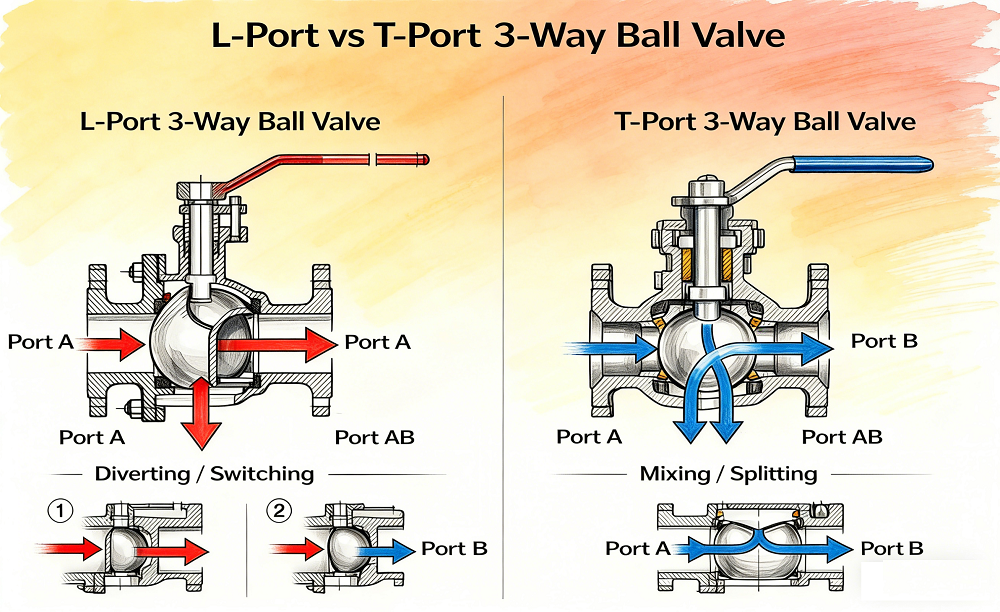
| Feature | L-Port Valve | T-Port Valve |
|---|---|---|
| Bore shape | L-shaped | T-shaped |
| Primary function | Divert flow from one inlet to one of two outlets | Mix two inlets into one outlet, or split one inlet into two outlets |
| Can connect all three ports at once? | No | Yes (in several positions) |
| Mixing capability | None | Full (two inlets, one outlet) |
| Splitting capability | None | Full (one inlet, two outlets) |
| Straight-through flow path | No | Yes (e.g., A to C, B closed) |
| Typical port configuration | One common port (inlet) + two alternating outlets | Any port can serve as inlet/outlet depending on need |
| Common applications | Tank switching, equipment bypass, seasonal diversion | Temperature blending, chemical mixing, parallel distribution |
| Actuator complexity | Simple (two positions) | Can be simple or multi-position (e.g., 0°, 45°, 90°) |
| Cost | Generally lower | Slightly higher due to more complex ball machining |
Selecting between an L-port and a T-port valve comes down to answering two fundamental questions:
Do you ever need to mix two separate fluid streams into one?
If yes → T-port is mandatory.
If no → L-port may be sufficient.
Do you ever need to split one incoming stream into two simultaneous outgoing streams?
If yes → T-port is required.
If no → L-port remains viable.
| Requirement | Recommended Valve |
|---|---|
| Route flow to either Tank A or Tank B (never both) | L-Port |
| Bypass a filter or pump while keeping the main line active | L-Port |
| Blend hot and cold water to a target temperature | T-Port |
| Split a chemical feed into two parallel reactors | T-Port |
| One valve that can do both diverting and mixing in different cycles | T-Port |
| Lowest possible cost for simple diversion duty | L-Port |
Important note: Some manufacturers offer “multi-port” or “full-port” T-port valves that allow infinite intermediate positioning for flow balancing. If modulating service is required, consult the valve supplier for seat material recommendations.
While L-port vs. T-port is the primary decision, other factors significantly impact long-term reliability:
Ball and seat materials: PTFE is standard, but for high temperatures or abrasive fluids, consider PEEK, reinforced PTFE, or metal-seated designs.
Actuation method: Manual levers are economical for infrequent operation. Pneumatic or electric actuators are preferred for automated systems or remote locations.
Port size and connection type: Threaded ends (NPT, BSP) for smaller diameters; flanged or butt-weld ends for larger pipes or high-pressure systems.
Pressure and temperature ratings: Always verify that the valve’s specifications exceed your maximum operating conditions.
For certain industries, even the T-port design may need modification. One notable example is the pigging ball valve—used in pipeline cleaning applications where internal inspection or product recovery pigs must pass through the valve without disassembly. These valves feature full-port bores and smooth internal transitions to prevent pig damage or sticking.
Other specialized variants include:
Sanitary 3-way ball valves (tri-clamp connections, electropolished surfaces for food/pharma).
High-pressure 3-way valves (for hydraulic systems up to 10,000 psi).
Cryogenic 3-way valves (extended bonnets and special seat materials for LNG service).
Understanding the distinction between L-port and T-port 3-way ball valve configurations is essential for efficient fluid control across industries ranging from chemical processing to HVAC, water treatment to oil and gas. While L-port valves excel at simple diversion tasks with lower cost, T-port valves offer unmatched flexibility for mixing, splitting, and multi-directional flow management.
Both designs share the inherent advantages of quarter-turn ball valves: durability, low maintenance, reliable shut-off, and suitability for high-pressure environments. By matching the internal bore geometry to your system’s actual flow requirements—rather than guessing—you can avoid costly rework, improve process efficiency, and extend service life.
With a commitment to quality and rigorous research and development, we offer the technical precision needed for demanding industrial applications. Whether you require L-port diverters, T-port mixers, or specialty pigging ball valves, our engineering team provides application-specific guidance and reliable products built for long-term performance.